Within Kashmir Śaivism, the body and the senses are not seen as obstacles to liberation but as vital instruments in the unfolding of higher awareness. This stands in contrast to the more ascetic attitudes found in classical Yoga traditions like Haṭha Yoga or the Pātañjala Yoga Sūtras. Rather than suppressing or transcending the senses, Kashmir Śaiva traditions cultivate them—recognizing the body as the field through which the Kundalinī Śakti, the coiled power of consciousness, awakens and reveals her full splendor.
This embodied orientation is exemplified in the work of Abhinavagupta, whose Tantrāloka synthesized the entire Śaiva Tantric canon into a unified vision. For Abhinava, ultimate awareness is not an abstract transcendence but a luminous recollection of Being that takes place within the body itself—a reawakening of the Kundalinī to her true nature as Paraśakti, inseparable from Śiva. So complete was Abhinava’s integration of the Trika vision that his very gestures and mudrās became spontaneous expressions of awakened, nondual consciousness.
The senses, in his vision, are not to be renounced but divinized—each one a portal through which the Goddess reveals herself. In his Hymn to the Wheel of Deities dwelling in the Body, he performs liturgical visualizations that identify the body with the cosmos, exalting the senses as goddesses themselves.
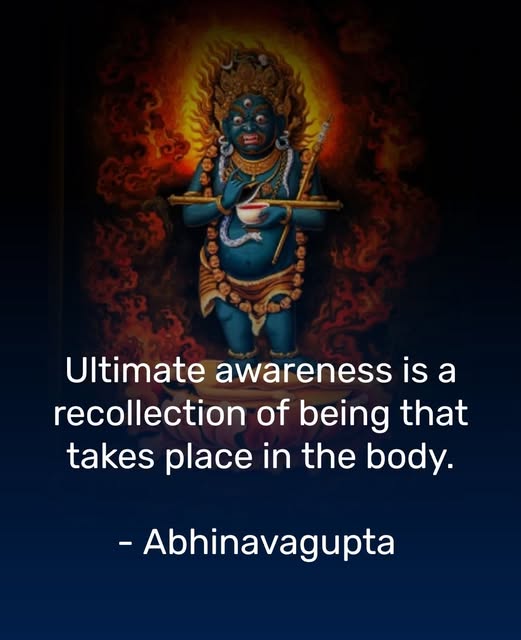
Yet beyond even the Trika stands a still more radical current: the Krama tradition—also known as the Mahānaya or Mahārtha path. While less known today, the Krama was historically more prolific and even more uncompromising in its nondualism. Here, the Kundalinī is not simply a latent force to be awakened, but is the Goddess Herself—fierce, ecstatic, terrifying in her capacity to consume illusion and deliver the practitioner into the blazing heart of truth. In Krama sādhanā, the body becomes not merely the vessel of awakening but the sacred site of the pilgrimage itself. The Goddess, immanent in every cell, leads the practitioner inward through visionary rites that subvert conventional cognition: the cremation ground becomes the inner terrain; its deities are aspects of awakened perception; and the journey culminates in the final dissolution of all forms into the blazing awareness of pure consciousness.
This ritual process, known as the Pīṭha-cakra, embodies the unique function of Śākta Tantra: to transmute ordinary subjectivity through the intensity of Kundalinī’s inner eruption. Here, awakening is not linear but explosive. The senses are not tamed—they are overwhelmed, seized, and sanctified, until all experience burns in the furnace of nonduality. In this light, Kundalinī is not a symbol of potential—it is the primordial fire of recognition (pratyabhijñā), the Goddess revealing Herself as both path and goal, body and cosmos, death and liberation.

…is a natural mystic, Śaiva-Śākta Tantrika and Jñāna Yogī. David holds degrees in Eastern Philosophy and Semiotics, lives in Japan with his family, and works as an author and teacher of the wisdom traditions, devoting his time to developing science-based tools and programs that help people reach the fullest potential of the human condition. This site is the legacy of the Himalayan Ashram—Uma Maheshwara Yoga & Ayurveda (UmaMaYA).
Would you like to share this article?

Discover more from REAL YOGA
Subscribe to get the latest posts sent to your email.