To properly answer the question of whether one might become possessed while engaged with the astral realms, we have to look more deeply at what’s really going on during astral projection.
When you “astral project,” what is leaving the body is not your soul or life force, but rather the astral body—a subtle, energetic double that exists in what we can call the astral plane. This plane is not “out there” in space; it’s a more subtle layer of consciousness that overlaps and interpenetrates this physical world. It’s the realm of thought-forms, emotion, and dream. The Akasha is the substrate of this realm—the field of subtle impressions, where all events, thoughts, and karmas are stored as vibrational imprints. It’s the memory of the universe.
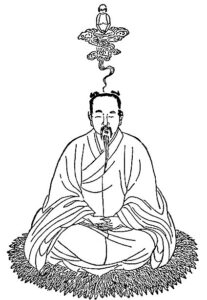
Now, within this field is also the dreamscape—the personal and collective terrain you travel when asleep or in trance. It’s shaped by your own psychic contents, as well as the broader collective unconscious, which holds the shared psychic architecture of humanity: archetypes, ancestral memory, and all the unresolved emotional and mental residues of generations. In that same field live egregores—formed entities created from collective belief, ritual, or repeated emotional charge. These aren’t “beings” in the way we think of aliens or spirits, but rather energetic intelligences shaped by accumulated thought, emotion, and will. Some are benign; others parasitic.
So—can your body be possessed while your astral body is “out”?
The short answer is: not exactly, unless you’ve left the door wide open already. Your astral projection doesn’t cause the danger—it only exposes what’s already vulnerable. Possession doesn’t happen randomly; it happens when there are cracks in the structure.
Those cracks come from what you carry inside—your own energy leaks, unresolved trauma, unconscious narratives, porous boundaries, or lack of sovereignty in your own mind. If you don’t know who you are, what you’re carrying, or how to stand firm in your own awareness, you can become a receptacle for unclaimed thoughts and forms—not because you left your body, but because you were never really in it to begin with.
Possession, in most genuine cases, isn’t about demons walking in. It’s about unclaimed material—your own, or collective—that finds a nest in your unguarded psyche. These may appear as voices, compulsions, strong opinions that aren’t quite yours, or even energetic attachments. But these come from the subtle field—from the Akasha and the collective dream—not from alien beings or rogue spirits looking for bodies to steal.
A person who walks consciously, with awareness of their own mind, with their stories examined and boundaries firm, is very hard to possess—whether they astral project or not. A person who seeks experience without purification, who meddles in realms without grounding, becomes vulnerable not because the realms are dangerous, but because they themselves are undefined.
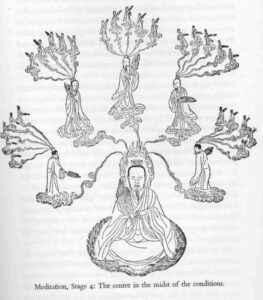
So the teaching is this: clean your house before you leave it. When you are sovereign in your energy—clear in intention, stable in self-awareness, and rooted in presence—then your body remains yours, and the astral realms become a mirror, not a trap.
Now take this a step further, and start to explore the ‘astral projection’ concept beyond what the new age promotes:
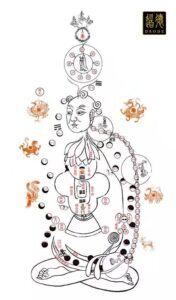
In the Tibetan Tantric tradition, which developed one of the most precise maps of the subtle body, the “astral body” isn’t a vague glow or a dream-self. It’s a carefully cultivated energetic structure composed of winds and drops—subtle currents and essences that move through an intricate network of channels that overlay the physical form. The Tibetans refer to various illusory bodies, such as the dream body or rainbow body, each accessed through refined yogic practice. The dream or astral body used in projection, or advanced dream yoga, is stabilized through control over these winds, particularly the life-supporting wind housed in the heart chakra.

This body doesn’t “float away” like in Hollywood stories, or modern astral projection workbooks—it is drawn out through deep internal practice, often involving breath retention, visualizations, mantras, and an empty, lucid awareness. It’s a controlled release of consciousness into the intermediate realms—what might be called bardo spaces, or the luminous in-between—not just a trip into a fantasy dreamscape.
When one projects consciously, with the winds under control, and awareness awake, the body is not lying empty like an unlocked house. Your vital essence does not abandon you. Rather, it remains tethered to the body via the central channel, especially when practice is done properly.
But, if your mind is weak, scattered, or filled with unresolved emotional patterns—if you have poor boundaries, if you identify with every passing thought or story—then your own psychic debris becomes fertile ground for possession. Not by spirits, per se, but by internalized thought-forms that don’t belong to your higher clarity. As mentioned above, these might appear as voices, compulsions, intense fantasies, or even spiritual delusions. They can originate from collective fear, cultural trauma, ancestral residue, or parasitic egregores—not from malicious external entities.
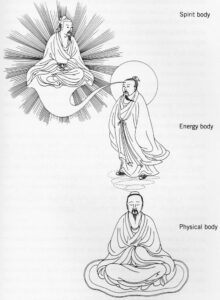
So to be clear, astral projection doesn’t open you to possession unless there is already a weakness in your structure. You aren’t a victim of the unseen; you are susceptible only to the degree that you are unconscious of what you carry within. Energy leaks—from trauma, unresolved stories, or fractured self-concept—create openings in your auric and subtle sheath. These openings don’t wait for you to astral project. They operate all the time.
The tantric masters didn’t warn against exploration—they taught preparation. Cultivating presence, refining the wind-body, learning to guard the gates of the senses, and practicing lucid awareness even in sleep. If you do this, you can move through the astral, dream, or bardo realms without confusion—and your body remains sealed and safe, your field unbreachable.
So again, possession isn’t a matter of whether you leave your body. It’s a matter of whether you’ve entered it fully, and claimed its inner space as sacred.

…is a natural mystic, Śaiva-Śākta Tantrika and Jñāna Yogī. David holds degrees in Eastern Philosophy and Semiotics, lives in Japan with his family, and works as an author and teacher of the wisdom traditions, devoting his time to developing science-based tools and programs that help people reach the fullest potential of the human condition. This site is the legacy of the Himalayan Ashram—Uma Maheshwara Yoga & Ayurveda (UmaMaYA).
Would you like to share this article?

Discover more from REAL YOGA
Subscribe to get the latest posts sent to your email.