
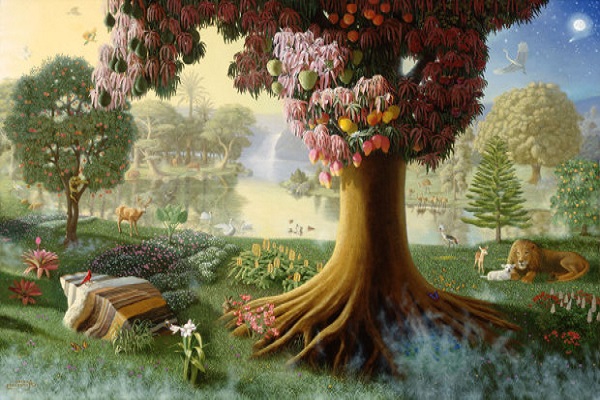
It’s about immortality; it always was. It’s about how to attain the Garden again – how to live forever in joy and innocence.
Devananda
Excerpt from Two Idiots & a Man
Volume I: In Search of the Steel
Prologue
“You are always dearest to me—I love You, I long for Your presence,” the young novitiate repeated slowly, gently mulling over the words of the ancient hymn.
“As You are so loved by me, so You are solved for me. You are present with me. You are always with me now because You are attained, solved—the problem is solved!”
Devananda closed the little book of Saivite sutras written by Utpaladeva over a thousand years ago, picked up his tea from its place on the ash-strewn hearth, and looked up at his teacher.
“When a man hears the truth,” the master said, “it rings inside of him like a bell.” He held his disciple’s eyes, then repeated the phrase, validating the young man’s bearing on the calm currents, nudging him onward with his study.
“But in order to get the answer,” Devananda hedged, beginning to tack back into the chop, “one needs to first be possessed by the question, as I was. The question is half the answer.”
The master bristled. His budding protégé was on a mission, perhaps naively so, to bring the teachings of their tradition to the public. There was still a lot of work to be done before that mission would bear fruit.
“Yeah. Anyway, know the truth,” the master chided. “Neti neti—it’s not this or that, heh?” he chuckled, his voice a dry rustle of leaves.
“Then what is truth, heh?” Swami Vinayagananda held the belay line fast, controlling his charge’s ascent lest he be blown off course by the tempestuous winds of the mind. The Swami could’ve been quoting Abhinava, Utpaladeva’s guru, but he wasn’t. He was speaking from within his own anuttara—the unsurpassed state, what the yogis also called svatantrya, or innate freedom—the highest state of God consciousness.
Devananda allowed himself to come to ground, trusting the master’s call to bhavana—to feel more deeply into the true reality. He knew that Baba Vinayagananda was nothing if not impeccable with his word, the spirit of those words consistently awakening worlds within him. Spirits, each and every one of them, mirrors of the face of God.
‘It’s about immortality; it always was,’ Devananda wrote, penning the words furtively, then gradually feeling the flow. ‘It’s about reclaiming the Garden—how to live forever in joy and innocence.’
Allowing his gaze to drift just beyond the portcullis above the tandoor, Devananda watched the deep midnight blues of dawn gradually come to life as the master tended the fire, the pupils of his eyes turning an eerie incandescent green in the glow of the burning embers. The master sat silently, the silence itself his student’s best muse.
“But is it wise to give the answer before the question has even been asked?” Devananda pondered aloud. “Few are inclined to acknowledge their deepest fear—the fear of death—in order to know what it truly means to live as both a man and a god.”
The master’s ears twitched as he grinned ever so slightly and nodded at his disciple’s growing awareness.
“Yeah. That’s right,” the master agreed. “The meaning of life is right there in the word. That’s for sure.”
“But it is not a one-word answer,” the young man countered.
“And nay it can be found by looking hither and thither, in books, or in the scriptures, or bought in a can from the shop,” the master returned wryly, almost irritably. Then his voice softened, and he looked compassionately once more at the young guy warming himself in front of the fire, pen in hand, ready to note down the baba’s every grunt and guffaw.
“Hey, the essence of life is in the experience, heh? What more meaning you can find?”
Swami Vinayagananda was an ardent proponent of direct experience, and he used his magic to design reality in such a way that his student’s experience would be most compelling. He often advised his apprentice to be on guard against the pitfalls of blind belief in another’s word, fervently admonishing attachment to any particular teaching—even those of his own tradition.
“Do what you are doing and be as a being; that is what the sages say,” the master continued. “And do it with a great interest! There you can find your meaning of a life, the purpose for which you are here.”
Devananda took a sip of chai, his mouth dry from all the smoking. The master always made the best chai, sweetened with copious amounts of condensed milk, a balm to balance the effects of the Himalayan charas, which was just beginning to nest properly in Devananda’s mind when he set his pen to the pad again.
‘Childhood finds the garden ripest,’ he began to note, ‘the fruits of the proverbial Trees of Life and Knowledge so appealing for their rainbow colors and sweet perfumes.’
Devananda was a romantic and quite enjoyed fancying himself a poet.
‘In the renaissance of my youth, I watched my spirit merge with the arts and sciences of being alive,’ he continued wistfully, ‘tracing the face of my Lord in myth and number. I witnessed the confusion of kin fallen prey to the influence of the demon spawn, and though I knew the source, could do naught but bemoan the senseless cycles of war and suffering—until at last, I too was lost.’
‘Then, the God I Am, before I was, before I knows the stories, disappears into the Word again, distorted by the meanings as I Babyl onward into every idea to find Him again…’
“Tell it simply so they can understand, guy,” the master coaxed, gently breaking the novice scribe from his reverie.
“I’m trying!” Devananda fairly exploded. “I swear—to tell the whole truth, so help me God, please,” he implored, amused by his own unintended pun, but unwilling to lose the heat of the passion that gripped him for fear that a smile might somehow dampen his resolve.
“I will show them my every mistake, Baba,” Devananda swore, faithfully. “For the sake of every child’s freedom, I will relay the entire journey and lay my soul bare to ridicule. Isn’t that the point after all? To show how a man can be a God and just a man at the same time?”
The young disciple looked pleadingly at his guru, who simply raised an eyebrow in reply.
“You’re right,” Devananda conceded, calming down, hearing the first chirpings of the early birds come to rest on the awning by the now smoldering smokestack that peeked out from the portcullis.
“My storytelling needs refinement. I have to find the right words.”
Read an Excerpt from Chapter 2: Steel & Stone

…is a natural mystic, Śaiva-Śākta Tantrika and Jñāna Yogī. David holds degrees in Eastern Philosophy and Semiotics, lives in Japan with his family, and works as an author and teacher of the wisdom traditions, devoting his time to developing science-based tools and programs that help people reach the fullest potential of the human condition. This site is the legacy of the Himalayan Ashram—Uma Maheshwara Yoga & Ayurveda (UmaMaYA).
Would you like to share this article?

Discover more from REAL YOGA
Subscribe to get the latest posts sent to your email.