A Brief Introduction to Dzogchen
Dzogchen, “the Great Perfection,” is the pinnacle teaching of the Nyingma tradition of Tibetan Buddhism. Rather than cultivating altered states or constructing gradual attainments, Dzogchen points directly to the natural state of awareness as it already is—open, luminous, and complete. It teaches that liberation is not something to be produced, but something to be recognized. All practices ultimately serve a single purpose: to reveal what has never been absent.
Dzogchen & Vajrayāna Tantra
Historically and canonically, Dzogchen is situated within Vajrayāna Buddhism, where it is classified as Atiyoga, the highest of the Nine Yānas. Yet Dzogchen is not simply another tantric system. While it may use Vajrayāna forms and transmissions when appropriate, its essential view does not rely on deity yoga, mantra accumulation, ritual elaboration, or subtle-body manipulation. For this reason, Dzogchen is traditionally said to be beyond both sutra and tantra: rather than transforming experience through method, it reveals liberation through direct recognition of what is already present.
Rigpa
Rigpa is the central recognition in Dzogchen: self-knowing, non-dual awareness. It is awareness that is aware of itself without effort or division. Rigpa is not a trance, a peak state, or an energetic high. It is the uncontrived clarity in which thoughts, sensations, and appearances arise and dissolve without leaving a trace. When rigpa is recognized, nothing needs to be rejected or grasped—experience self-liberates in its own unfolding.
Samantabhadra
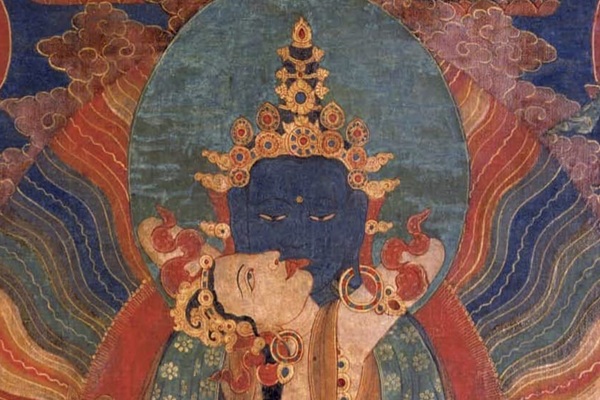
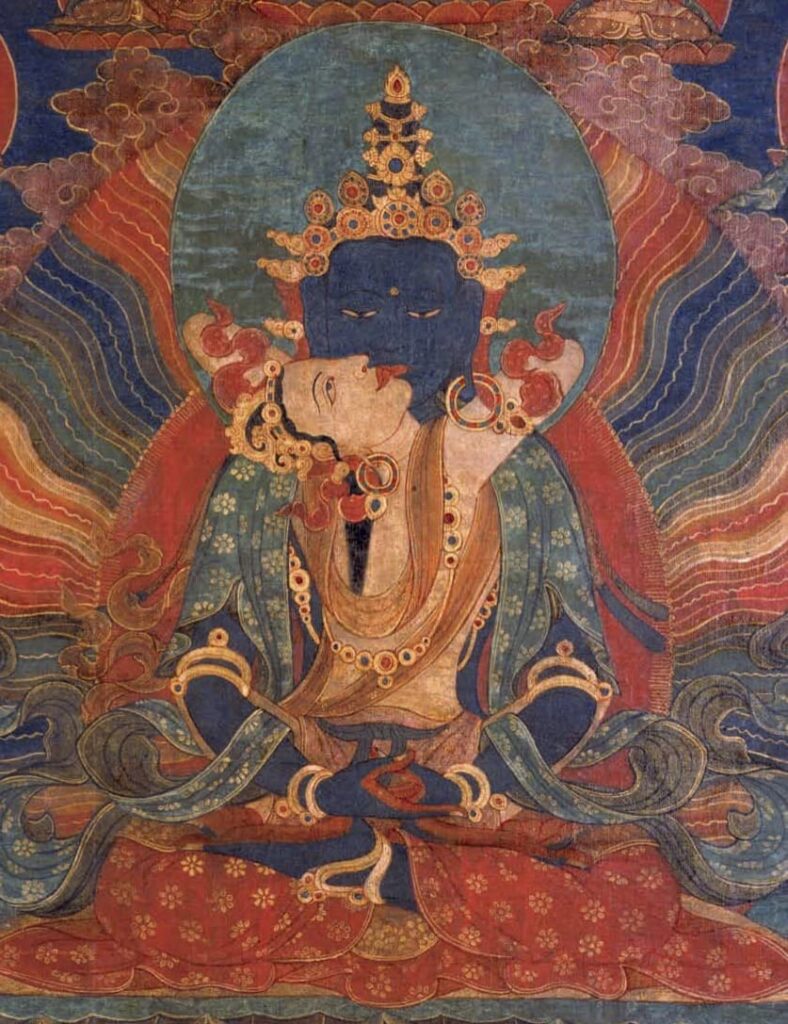
In Vajrayāna and Dzogchen iconography, Samantabhadra appears with a goddess on his lap because he is almost never depicted alone. The pairing expresses a central tantric truth: awakening is not a solitary, abstract principle, but the inseparability of awareness from its expressive power.
Samantabhadra (Skt. Samantabhadra; Tib. Kun-tu bzang-po) is the primordial Buddha in Dzogchen—not a historical figure, but the personification of primordial, self-knowing awareness. His consort is Samantabhadrī (Kun-tu bzang-mo), who embodies the luminous, empty expanse in which that awareness appears.
Their union represents nonduality: method and wisdom; clarity and emptiness; appearance and awareness; masculine skillful means (Upāya) and feminine prajñā. Prajñā being the direct, non-conceptual knowing that sees things as they are, rather than as they are filtered through habit, ego, language, or belief. It is not intellectual knowledge (jñāna as information), but experiential clarity.
This is why the image uses the yab-yum form (See image above). It is not erotic symbolism in a conventional sense, but an ontological one. Enlightenment is not attained by suppressing form, energy, or embodiment; it is realized when these are known to be inseparable from emptiness itself.
More precisely, Samantabhadra represents rigpa recognizing itself. Samantabhadrī represents śūnyatā (emptiness) as the great, unbounded space. Śūnyatā is the insight that nothing exists in its own right, but rather all things arise dependently, through causes, conditions, relations, and designation. Because they are dependently arisen, they are “empty” of any permanent essence.
Without Samantabhadrī, Samantabhadra would collapse into a subtle eternalism—pure awareness with no field of manifestation. Without Samantabhadra, Samantabhadrī would tend toward nihilistic emptiness—vast, but unknowing. Their union corrects both extremes.
Iconographically, the goddess sits on his lap, not as possession, or as conjugal union, but as identity. She is not a secondary figure; she is the mode in which awakening knows itself. That’s Kuṇḍalinī. The mode by which you know yourself! In some Dzogchen texts, Samantabhadrī is even said to be primary, with Samantabhadra arising from her expanse.
A Crucial Teaching in the Light of the Kuṇḍalinī Phenom
Suffering does not arise from experience itself, nor from energy, emotion, or even intense awakening phenomena. It arises from clinging—from the subtle contraction that tries to own experience, stabilize it, or identify as it. Dzogchen points out something both radical and relieving: when grasping relaxes, suffering dissolves on its own.
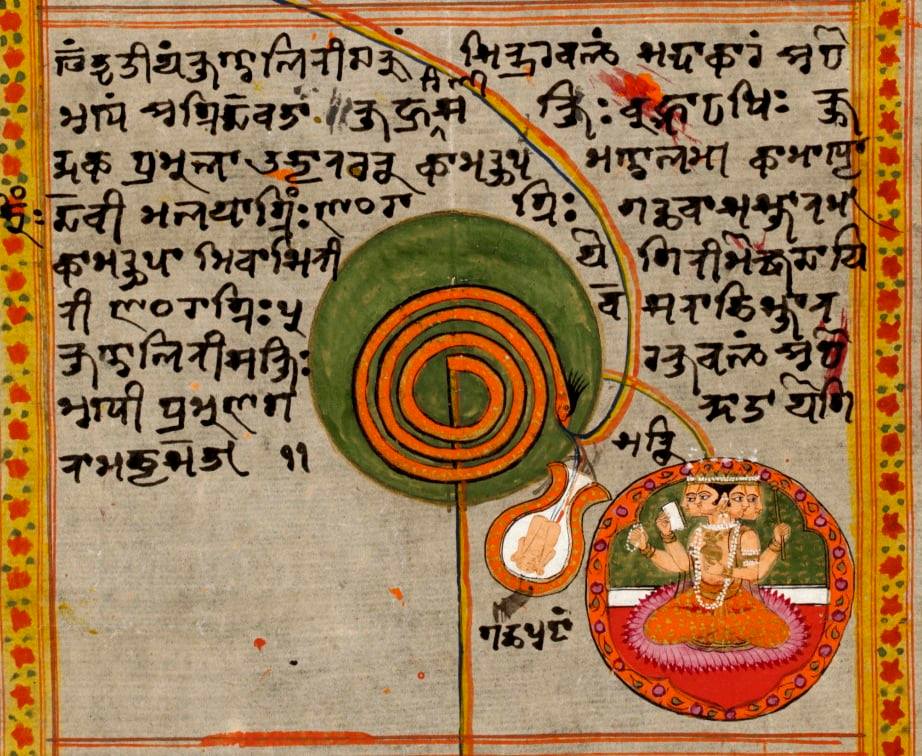
In conversations around Kuṇḍalinī, this clinging often appears as fixation in the system—energy caught in knots, loops, or self-reinforcing patterns. Yet the deepest knot is not energetic but identificatory. When awareness tightens around sensation, bliss, fear, or insight, the natural flow of Kundalini is disrupted. When awareness relaxes, energy releases spontaneously, just as prāṇa untangles itself when it is no longer forced.
Rigpa, therefore, is not something Kundalini produces, but that which Kuṇḍalinī reveals when it is allowed to move without appropriation. Classical Tantra expresses this as Śakti freeing herself when Śiva is recognized as already present. In the same way, Dzogchen shows that awareness does not need management—only recognition. The moment experience is no longer claimed as “mine,” the sense of a separate self softens, and the machinery of suffering unwinds.
From this perspective, liberation is not escape from the body, emotions, or the world. It is intimacy without ownership. Energy may surge or settle, chakras may open or quiet, visions may arise or fade—but without clinging, all of this is simply the display of awareness. Like breath moving freely in an open body, or mantra dissolving into silence, experience completes itself.
The invitation is not to suppress Kuṇḍalinī, nor to chase it, but to recognize the awareness in which it unfolds. When there is no grasping, even powerful awakening processes become self-liberating rather than destabilizing. Samsara and nirvana are not two places, but two ways of relating to the same living reality.
Nothing needs to be held.
Nothing needs to be fixed.
What you are has never been bound.

…is a natural mystic, Śaiva-Śākta Tantrika and Jñāna Yogī. David holds degrees in Eastern Philosophy and Semiotics, lives in Japan with his family, and works as an author and teacher of the wisdom traditions, devoting his time to developing science-based tools and programs that help people reach the fullest potential of the human condition. This site is the legacy of the Himalayan Ashram—Uma Maheshwara Yoga & Ayurveda (UmaMaYA).
Would you like to share this article?

Discover more from REAL YOGA
Subscribe to get the latest posts sent to your email.