In his book, Tantra Illuminated, Dr. Christopher Wallis explains that “Nondual Śaiva Tantra holds that one thing alone exists: the Divine, in various permutations. To say that God alone is real is the same as saying everything that exists is God, everything is divine. In NŚT, to experience this divinity in and as all things is the goal of the practice. The Divine is here taught as having two aspects, the transcendent and the immanent.
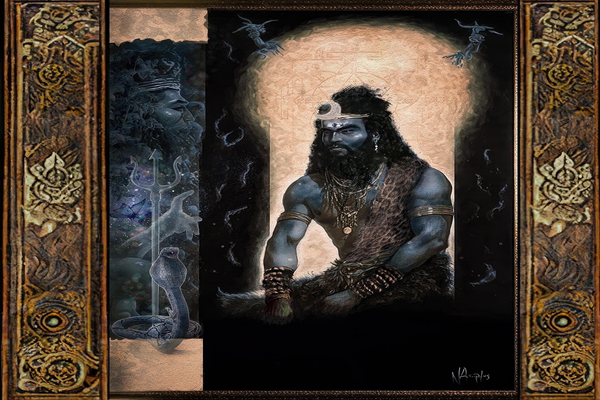
The transcendent aspect is called Śiva (SHEE-vuh) and personified as male divinity (sometimes, God). Though Śiva is represented mythologically as having certain characteristics, Tāntrikas (followers of the Tantra) understand Śiva as pure Consciousness: nonpersonal, utterly transcendent of all limitations or qualities, beyond the reach of senses, speech, and mind—in short, the singular Light of Awareness that makes possible all manifestation; the quiescent and peaceful ground of all that is.
The immanent aspect of the divine (“immanent” means perceivable through the senses and the mind) is called Śakti (SHUCK-tee) and personified as female divinity (Goddess). That is, the entire manifest universe is the Goddess, and therefore ought to be reverenced as such.
Now, Śiva and Śakti are actually one, not two, but are represented as two because they correspond to two interdependent aspects of reality, one of which is predominant in any given moment of experience.
The two different experiences of the Divine represented by Śiva and Śakti are the enstatic, in which we turn within, let go of everything, and reach the quiescent and transcendent ground of our being; and the ecstatic, in which we express our divine nature in creative, dynamic, outward-going, and embodied ways.
According to NŚT, both modes are necessary to fully know the Divine, and a harmonious balance of both is the only true spiritual liberation. The cultivation of this state of awakened freedom originally took place in the context of a spiritual community guided by a spiritual master. (He was called a master not because he was everyone’s boss but because he had completely mastered himself.) Though people were traditionally required to take initiation formally in order to have access to the guru and to the scriptures (this tradition of formal ritual initiation fell away about 100 years ago), it is important to note that initiates were not required to renounce their jobs, possessions, or family life. That is to say, the Tantra was mostly a “householder” path, and renunciates were the minority. The practitioners of Tantra were people like you and me, and they dealt with many of the same challenges of everyday life that we face today. They joined a kula, or spiritual community that rejected the significance of caste, class, and gender divisions, and they practiced a life-affirming spiritual discipline.
While meditation, mantras, and ritual are central to NŚT, these are also found in many other forms of Indian spirituality. What NŚT added was its innovative yogic techniques of the subtle body, plus the revolutionary notion that virtually anything can become a form of spiritual practice. This idea is based on the teaching that all things are manifestations of the Goddess. Therefore the body was seen not as a locus of sin and impurity, as in the pre-Tantrik tradition, but rather as a vehicle to realize divine reality. This led to a new emphasis on practices focused on the body and its energies and to the detailed mapping of the structure of the universe onto the body, which was seen as a microcosm of the whole.
Likewise, the experiences of the senses were not viewed as distractions from spirituality but as opportunities to engage in divine worship. This was a more effective approach for people living in the world, for spiritual practice was no longer limited to ritual acts or ascetic renunciation. Thus this path was sometimes called “the new and easy method” (nava-sukhopāya). NŚT teaches that for an experienced meditator, even mundane daily actions like washing the dishes and walking the dog are opportunities for experiencing the joy that flows naturally from the holistic awareness of being in full Presence.
Though NŚT shares many similarities with other nondual mystical paths, we honor the tradition by reserving the word Tantra for the lineage teachings that were based on the revealed scriptures called tantras.”
From Tantra Illuminated by Dr. Christopher Wallis

Not so much an aside, but offered here because the concept is so intimately connected with the above view:
“The term Kuṇḍalinī refers to Śiva’s power of Emission (visarga-śakti) which, inasmuch as it is universal, is identical with I-ness (ahaṃtā) in its fullest expansion (i.e., divine identity free of any contraction or separation). The revealed texts of our tradition say that She has three and a half coils. Of these, the first is that mode of selfhood in which the objects of cognition predominate, the second that in which the act of cognition predominates, the third that I-ness in which the cognizer predominates, while the remaining half-coil is that ‘I’ whose essential nature is the state of pure awareness.” (Transl. Wallis)
May your practice bear fruit!
And may all beings everywhere know freedom.

…is a natural mystic, Śaiva-Śākta Tantrika and Jñāna Yogī. David holds degrees in Eastern Philosophy and Semiotics, lives in Japan with his family, and works as an author and teacher of the wisdom traditions, devoting his time to developing science-based tools and programs that help people reach the fullest potential of the human condition. This site is the legacy of the Himalayan Ashram—Uma Maheshwara Yoga & Ayurveda (UmaMaYA).
Would you like to share this article?

Discover more from REAL YOGA
Subscribe to get the latest posts sent to your email.