
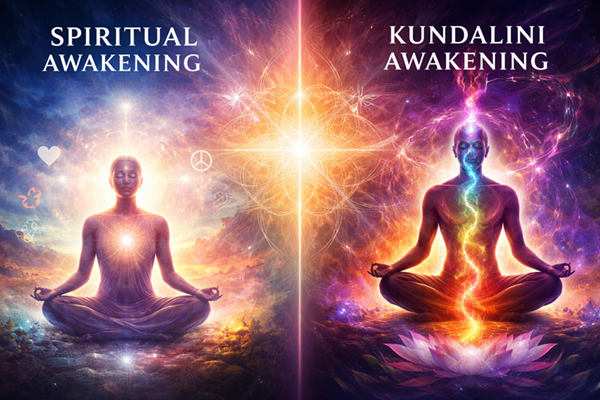
Spiritual Awakening vs. Kuṇḍalinī Awakening: A Map for the Terrain
What’s the difference between a spiritual awakening and a Kuṇḍalinī awakening?
This is one of those questions that demands we slow down, because the words we use—spiritual, Kuṇḍalinī, even awakening—have been stretched, borrowed, and all too often stripped of their original power.
Let’s break this down through three lenses: the modern spiritual narrative, the tantric cosmology, and the lived experience of the body.
Spiritual Awakening: The Shift in Perspective
Spiritual awakening is often described as a fundamental reorientation of consciousness—a cracking open of the ego’s illusions to reveal a deeper truth beneath the surface of daily life.
This “aha!” moment can be catalyzed by trauma, psychedelics, near-death experiences, deep meditation, or the slow burn of existential questioning, as in 12-step programs like AA/NA where “hitting bottom” forces surrender to a higher power.
The hallmarks are distinctive: a dissolution of old identities (“I am not my thoughts, my job, my past”), transpersonal insights like unity consciousness or the recognition of separation as illusion, emotional purges of grief or joy or terror as the psyche realigns, and synchronicities that create a sense of being guided by something larger than yourself.
What emerges is a paradoxical state—feeling both insignificant and divine simultaneously. In transpersonal psychology (Jung, Grof, Wilber), this is framed as individuation or non-dual realization. In philosophy, it echoes Plato’s allegory of the cave or Nietzsche’s “become who you are.” The New Age might call it “ascension” or “5D consciousness.” But at its core, it’s a shift in how you perceive reality—not necessarily a transformation of the energy system itself.
The key distinction: spiritual awakening is often mental and emotional—a seeing of truth. It can be gradual or sudden, and while it may include energetic shifts, it doesn’t inherently involve the systematic rewiring of the body’s subtle anatomy.
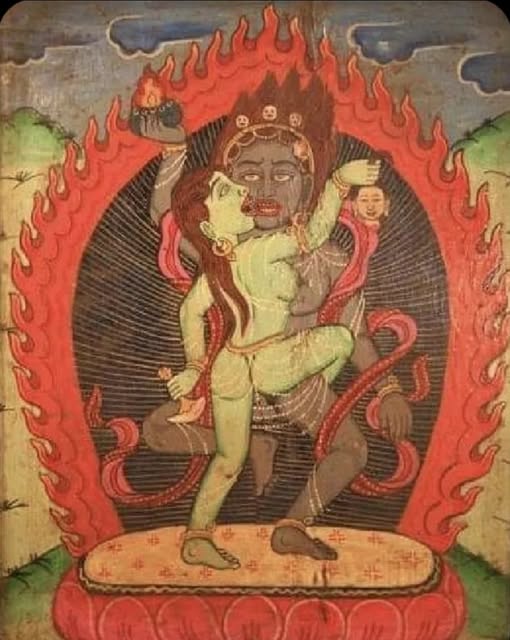
Kuṇḍalinī Awakening: The Threefold Fire of Creation
Kuṇḍalinī is not merely an “awakening”—it is the activation of the primal creative force (Śakti) within the human system, mirroring the cosmic process of manifestation itself. Here’s where the confusion arises: Western contexts often reduce Kuṇḍalinī to a “powerful spiritual experience,” but in Tantra (Śaivism・Śāktism), it’s a literal recapitulation of the universe’s birth within the individual.
The Tantric Framework
In Kashmir Śaivism and Śāktism, Kuṇḍalinī is Śakti herself—the dynamic, creative power of the divine, coiled like a serpent at the base of the spine. When she awakens, she repeats the act of cosmic creation within the human body through a threefold process (described in texts like the Shat-Chakra-Nirupana (An Exposition of the Six Cakras) and Śiva Saṁhitā (The Compendium of Śiva):
- Icchā Śakti (Will/Potential): The desire to create—the coiled serpent stirs.
- Jñāna Śakti (Knowledge/Wisdom): The awareness that directs the energy upward through the nāḍīs (subtle channels).
- Kriyā Śakti (Action/Manifestation): The active unfolding of the energy through the chakras, purifying and rewiring the system.
The Threefold Kundalini: Cit, Jñāna, Prāṇa
Just as the cosmos arises from the threefold dynamic of Śiva-Śakti (Will-Knowledge-Action), Kuṇḍalinī manifests in the human body as three interwoven currents—each a face of the same divine energy, but with distinct expressions:
- Cit-Kuṇḍalinī (Intelligence: Primal and Personal)
- Corresponds to Icchā Śakti (Will) but is pure awareness itself—the witnessing presence that knows the energy.
- Experience: The luminous void behind all phenomena. When stirred, it dissolves the illusion of separation (e.g., sudden samādhi or non-dual recognition).
- Mythic Role: The “I Am” before thought—the Śiva principle within Kuṇḍalinī.
- Jñāna-Kuṇḍalinī (Wisdom Power of Awareness)
- Corresponds to Jñāna Śakti (Knowledge) but is the discriminative intelligence that guides the energy.
- Experience: Inner knowing without logic—visions, symbolic dreams, or direct cognition of truth (e.g., “I am the universe”).
- Mythic Role: The Goddess as the Word (Vāk), the soundless sound that structures creation.
- Prāṇa-Kuṇḍalinī (Vital Power)
- Corresponds to Kriyā Śakti (Action) but is the raw life force that moves the energy.
- Experience: Heat, vibrations, involuntary movements (kriyas), or breath suspending as prāṇa floods the sushumnā.
- Mythic Role: The Serpent Herself—the coiled potential that, when stirred, unfurls as the world.
These three are not sequential but simultaneous, like the three strands of a braid. A “full” Kuṇḍalinī awakening involves all three—consciousness recognizing itself (Cit), wisdom directing the flow (Jñāna), and energy reshaping the body (Prāṇa).

The Coiled Serpent: Not Asleep, but Veiled
A critical clarification: Kuṇḍalinī is not “sleeping” at the base of the spine. She is always alive—after all, you are breathing, digesting, dreaming. But her full spectrum is obscured by saṁskāras (karmic imprints) and the contraction of the ego, which filters her power into survival-mode energy.
When she “stirs,” it’s not that she wakes up—it’s that the veils thin. The dam breaks. The fire you’ve always carried suddenly burns with the intensity of a thousand suns.
Before stirring, Kuṇḍalinī is like a river dammed—still flowing, but constrained to small channels (digestion, reproduction, fight/flight).
When stirred: The dam cracks. The river becomes a flood, reclaiming its full course through the suṣumṇā (central channel) and rewiring the system to hold more light, more life, more truth.
This is why the tradition says:
She is not awakened—she is recognized.
Tantraloka, Abhinavagupta
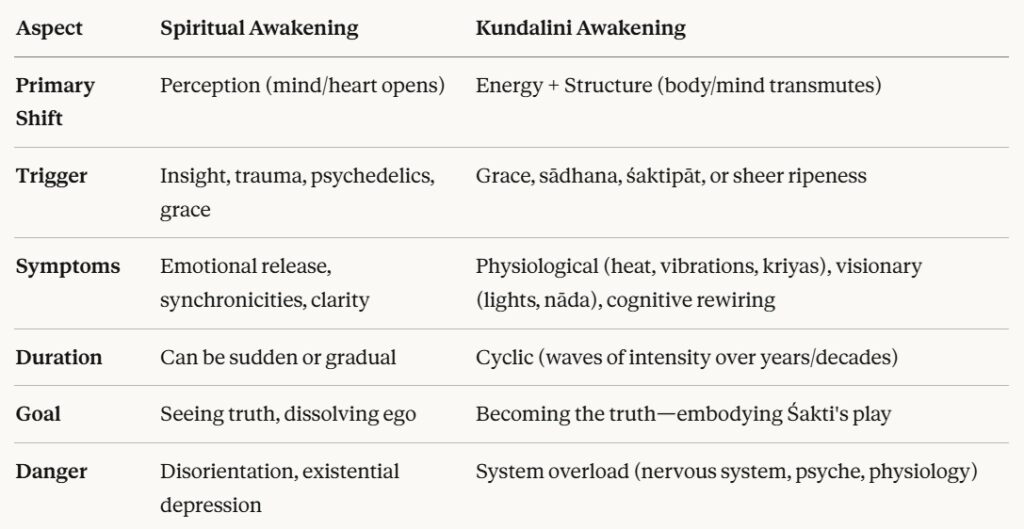
Practical Implications: How to Discern Which Is Which
Note: This chart is by no means all-encompassing. The boundaries between spiritual and Kuṇḍalinī awakening are fluid and often overlap. This overview is meant to serve as a starting point for discernment, not as a definitive diagnostic tool. Your lived experience may contain elements of both, or move between them in ways this chart cannot capture.
Why the Confusion?
The West often strips Kuṇḍalinī of its tantric context, treating it as a “supercharged spiritual experience” rather than a sacred, dangerous, and transformative initiation into the mystery of existence itself. This cultural appropriation has created a distorted landscape where the term is divorced from the cosmology, practice, and lineage that give it meaning. Simultaneously, the boundaries between these two phenomena are permeable in ways that deepen the confusion. A Kuṇḍalinī awakening can trigger a spiritual awakening—that shift in perspective—but the reverse isn’t always true. Many people have profound spiritual openings without Kuṇḍalinī rising at all, yet they may interpret their experience through a Kuṇḍalinī lens because that’s the narrative they’ve encountered.
Adding to this murky territory is the problem of mislabeling. Prāṇic surges, trauma release, or even psychological crises like bipolar mania are sometimes mistaken for Kuṇḍalinī awakening. The body’s response to shock, the mind’s fragmentation under stress, and the nervous system’s dysregulation can all produce symptoms that superficially resemble a Kuṇḍalinī process—heat, involuntary movement, altered perception. Without proper context and witness, it’s nearly impossible to discern which is which. This is precisely why the traditions insisted on a guru: not as a spiritual authority figure, but as someone who could distinguish between genuine Kuṇḍalinī and its counterfeits.
The Cosmology of Kundalini: “As Above, So Below”
In Tantric philosophy, Kuṇḍalinī is not separate from the creation of the universe. The same threefold dynamic that birthed the cosmos—Will, Knowledge, Action—is replicated in the human body. Ākāśa, or space, is the “great void” within which creation arises, mirrored in the cavity of the heart known as hṛdayākāśa.
The descent of consciousness itself is the union of Śiva, pure awareness, with Śakti, dynamic energy, manifesting the world. In the human, this same marriage occurs when consciousness and Kuṇḍalinī rise together through the suṣumnā, the central channel.
When Kuṇḍalinī rises, you’re not simply “waking up”—you’re participating in the act of creation itself, recapitulating in your own body what the universe has already done.
This is why a true Kuṇḍalinī awakening often feels like death and rebirth, as the old self dissolves. It is a reclaiming of innate power—the Goddess remembering herself through you. It is a call to embodied action, not passive enlightenment, but divinity in motion.
Just as the fire latent in wood burns it to ashes when kindled, so the Kuṇḍalinī Śakti, when awakened, reduces the body to ashes and leads to liberation.
Śiva Saṃhitā
The fire consumes what you were so that what you truly are can emerge.
A Word of Caution (And Hope)
Kuṇḍalinī is not a “level up”—it’s a plunge into the unknown, a surrender to forces far greater than the personal self. While spiritual awakening can feel like coming home, Kuṇḍalinī often feels like being rebuilt from the ground up. This is why the traditions warn: do not awaken the serpent unless you are prepared to be consumed by the fire. The body may not be ready for the voltage. Physical overload manifests as chronic fatigue, insomnia, or nervous system dysregulation when the energy isn’t properly grounded. Simultaneously, the shadow self rises with the light. Unprocessed trauma, fears, and repressed emotions surface all at once, leading to anxiety, depression, or even temporary psychosis if not held with care and witness.
Beyond the physiological and psychological terrain lies another pitfall: spiritual bypass. Some mistake Kuṇḍalinī for “enlightenment” and skip the hard work of integration, leading to grandiosity or dissociation from the body altogether. And perhaps most insidious is the isolation that accompanies the process. Because the experience is so intense and utterly personal, many feel profoundly alone in it, especially if their community doesn’t speak the language of what’s happening or dismisses it as pathology rather than transformation.
This is precisely why the traditions insisted on non-negotiable supports. A qualified guru who knows the terrain is essential—not as a spiritual authority dispensing wisdom from on high, but as someone who has walked the fire and can distinguish between genuine process and derailment. A stable practice of meditation, prāṇāyāma, and āsana contains the energy and prevents it from fragmenting the nervous system. Grounding practices—earth, water, simple routines—anchor the fire so it doesn’t consume you. And most crucially, surrender—not to the experience itself, but to the intelligence guiding it, the Kuṇḍalinī herself, who knows exactly what she’s doing even when your mind cannot fathom it.
The Middle Ground: Chin up! You Aren’t Broken
If you’re reading this because you’re in the thick of it, you’ve likely already encountered a hundred voices screaming about Kuṇḍalinī —each one more dramatic than the last. Social media has made it trendy. Spiritual entrepreneurs have made it profitable. And people like Gopi Krishna, speaking from their own fractured experience rather than from an actual tradition, have made it sound like a neurological catastrophe wrapped in mystical language.
This noise is part of your problem.
What you need is not more sensation. You need context. Not poetry without practice. Not warnings without wisdom. Not someone else’s breakdown presented as your roadmap.
The traditions understood something crucial: Kuṇḍalinī is not a solo event. It’s a process that requires three things simultaneously—a map (cosmology—lineage/scripture), a method (sādhana—practice), and a mirror (guru). Without all three, you’re just burning.
The traditions knew this because they lived it. They built practices specifically designed to ground the fire, to direct the energy, to keep the nervous system from fragmenting under the voltage. Prāṇāyāma. Āsana. Meditation. Mantra. These aren’t decorative—they’re load-bearing walls.
When those walls are absent, when someone awakens Kuṇḍalinī through accident or grace or recklessness without the container to hold it, they’re left with only their own experience to interpret. And the human mind, under duress, will reach for whatever narrative is loudest. Gopi Krishna’s narrative became loud. It became a template. And now countless people are reading their own experience through his lens of doom, when their experience might be asking something entirely different.
This is why you’re here. Not to find another voice screaming at you from the internet. But to find people who know the difference between Kuṇḍalinī and nervous breakdown, between crisis and initiation, between the map and the territory—because they’ve walked it within a lineage that knows how to hold it.
So which is “better”? Neither. They’re different movements of the same divine dance. Spiritual awakening gives you the eyes to see the truth, while Kuṇḍalinī awakening gives you the hands to shape it. One is the realization of what is; the other is the embodiment of it. Both are necessary, and both are sacred.
When the breath moves in the central channel, the mind dissolves into the void,
and the state beyond mind is attained.Vijnana Bhairava Tantra ||15
This isn’t just about seeing the divine—it’s about becoming the channel for it.
What to Do Now (A Practical Guide)
If you’re in a spiritual awakening, observe without clinging and let the new perspective settle before acting on it. Journal, meditate, and integrate the shifts by asking yourself: “What old story is falling away? What wants to be born?” Find community—you’re not alone in this shift, and witnessing others navigate similar terrain can ground your own experience.
If you’re in a Kuṇḍalinī awakening, get on the earth. Walk barefoot, hug trees, let your body remember its connection to the planet. Simplify your life radically by reducing stimuli—social media, caffeine, loud environments. Find a teacher, someone who knows Kuṇḍalinī not just in theory but in lived experience, who can distinguish between genuine process and derailment. And perhaps most importantly, trust the process. Even the darkness is part of the path; the shadow rising is not a sign of failure but of the energy doing its work.
If you’re unsure which is which, ask your body. Spiritual awakening often softens the edges of reality; Kuṇḍalinī electrifies them. Watch for synchronicities—the universe will mirror what’s happening inside you, offering clues if you’re paying attention. And don’t force it. If it’s Kuṇḍalinī, it will make itself known with unmistakable intensity. If it’s spiritual awakening, gentleness is the key—surrender to the unfolding rather than grasping at it.
So, Spiritual or Kundalini?
Both paths are sacred. Both are challenging. And both are gifts. Remember this: spiritual awakening can happen without Kuṇḍalinī, and many profound spiritual openings never involve the rising of the serpent at all. But Kuṇḍalinī awakening will always bring spiritual insight—the shift in perspective, the dissolution of illusion, the recognition of your true nature. The difference is that Kuṇḍalinī will also demand everything from you. She is not gentle. She is not optional. She is the Goddess herself, and when she moves, the world moves with her.
As my teacher used to say: “Neti. Neti. The truth is neither this nor that—so what then is the truth? Whatever it is, you can recognize it, or you can be consumed by it. The first is a sunrise—an awakening. The second is a wildfire. Both illuminate. But one allows you to witness the light; the other demands that you become the light, burned down to your essence so that nothing but truth remains.
So the question isn’t which is happening to you. It’s: Are you ready to meet it? Are you prepared to be undone so that you might be remade?
That is the real inquiry.
That is where discernment begins.

…is a natural mystic, Śaiva-Śākta Tantrika and Jñāna Yogī. David holds degrees in Eastern Philosophy and Semiotics, lives in Japan with his family, and works as an author and teacher of the wisdom traditions, devoting his time to developing science-based tools and programs that help people reach the fullest potential of the human condition. This site is the legacy of the Himalayan Ashram—Uma Maheshwara Yoga & Ayurveda (UmaMaYA).
Would you like to share this article?

Discover more from REAL YOGA
Subscribe to get the latest posts sent to your email.