
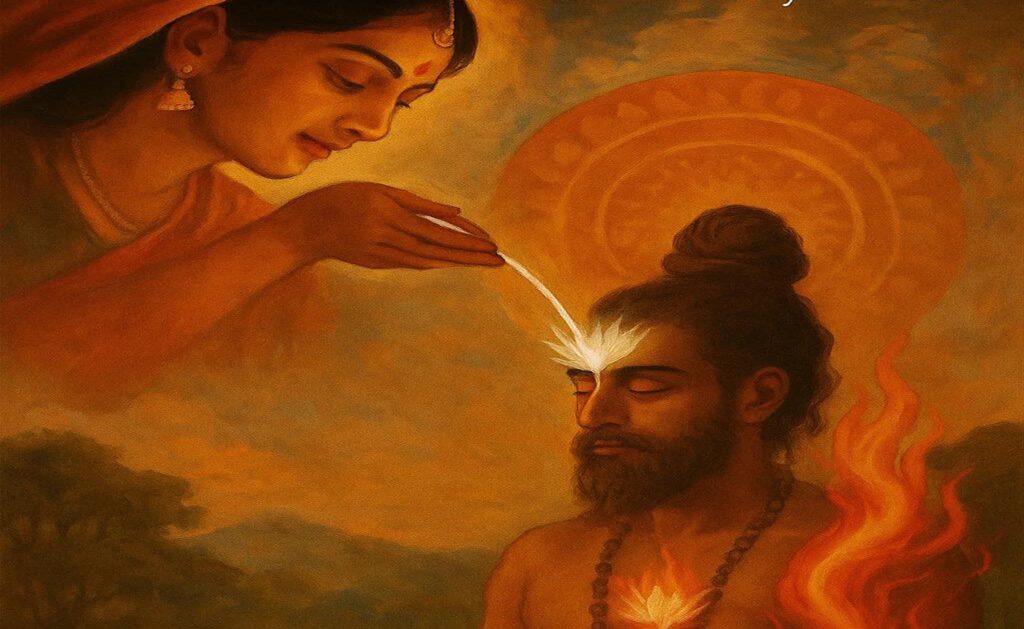
Bhavana Krama is the Practice of Feeling into Reality
Bhāvanā means cultivation, bringing-into-being, contemplative development
Krama means sequence, stages, progression
So Bhāvanākrama means: The Stages of Meditation or The Sequence of Cultivation.
This is also the title of the famous trilogy by Kamalaśīla (8th CE), foundational for Mahāyāna Buddhist meditation theory.
Bhāvanākrama is a unique yogic practice in which you hold space, or give presence to, or feel into the whole of something—the Sampurna.
Bhāvanākrama is said to be the essence of all yogic practices (abhyāsa) in general, too.
There are many kinds of meditative practices; mindfulness of a particular object, or state of being, is a popular practice. Focus and concentration exercises, Silence exercises, guided exercises for a host of attainments and goals—so many ways to explore reality.
Bhāvanākrama asks you to be with an experience fully. To absorb that experience and let it permeate you. To let it subsume you until you digest it properly, and then, ideally, let it wash off so that you do not accrue the karma. But that’s another conversation.
This article is being put forward to support your practice in the context of self-study (svādhyāya), with books and scripture, or the words of teachers you listen to on podcasts or video. Bhāvanākrama becomes a tool to help you digest what you take in.
You need adequate digestive fire to break down, assimilate, and allow what you’ve eaten to be transformed into nutritious sustenance.
That fire is kindled with other practices, like guided or self-meditation, ritual devotion, chanting, and physical practices like exercise, yoga asana, dance—feeding the body with proper nutrition at every level. Sometimes the fire of mental digestion is even kindled by smoking a good joint. Psychedelics, on the other hand, while lubricative, do little for the fire.
Bhavana itself will fan the flames. Bhavana, steady contemplation of the reality, will keep the wood burning and the hearth warm.
Try this practice:
Choose a piece of literature. Even this article will do. Choose a point of focus. Slowly, gently, let the information marinate. Feel into it. You don’t have to apply effort. You don’t have to think, or analyze overtly. You can just let it be.
Like the sentence, third from the top: “Bhavana Krama is said to be the essence of all yogic practices (abhyāsa) in general, too.” It’s a truth statement. But that truth hasn’t been assimilated yet, even if it has been intellectually understood. If that truth were yours, you’d be living it already.
You can work with the statement a few minutes, or a few days. But work it. ONE Make sure that the passage you read is resonating with you, that you are understanding at an intellectual level and that there is some agreement, or at least some space to consider the perspective. If you find that comprehension, or even surface respect eludes you, try to massage the words a little, gently tweaking your perspective. But if it doesn’t resonate, move on. Don’t force it. Acknowledge the gap.
Here’s another truth statement, perhaps one of the most profound of all truth statements. Get this, and it’s said you need no other.
Tat tvam asi—You are that (Divinity which you seek).
Take a breath, center yourself. See if you can just imagine, or feel a little bit of the power of this pure truth statement.
“This very highest divinity, the self-manifest light of consciousness, is always already my very own being. When that is the case, what could any method of practice achieve? Not the attainment of my true nature, because that is eternally present; not making that nature apparent, because it is constantly illuminating itself; not the removal of veils, because no ‘veil’ whatsoever exists; not the penetration into that, because nothing other than it exists to enter it. What method can there be here, when there is an impossibility of anything separate from that?
Therefore, this whole existence is One Reality: Consciousness alone—unbroken by time, uncircumscribed by space, unclouded by attributes, unconfined by forms, unexpressed by words, and unaccounted for by the ordinary means of knowledge. For It is the cause alone,, through Its own will alone, by which all these sources of limitation, from time, to the ordinary means of knowledge, attain their own natures.
This Reality is free and independent, a mass of bliss, and that alone am I; thus the entire universe is held as a reflection of me.”
Tantrasara Ch. 2 — Abhinavagupta
If you can grasp this, intuitively, right here, right now, then you’re done. You’re free. Go and live your life in joy. Practice finished. But if you’re unable to sit comfortably with your ultimate empowerment, your freedom, then you’re going to have to practice more until you can.
If you’re really burning for a good practice, check out the program library. Find the Step Two: Wisdom in Practice (Jnana Yoga) program and dive in.

…is a natural mystic, Śaiva-Śākta Tantrika and Jñāna Yogī. David holds degrees in Eastern Philosophy and Semiotics, lives in Japan with his family, and works as an author and teacher of the wisdom traditions, devoting his time to developing science-based tools and programs that help people reach the fullest potential of the human condition. This site is the legacy of the Himalayan Ashram—Uma Maheshwara Yoga & Ayurveda (UmaMaYA).
Would you like to share this article?

Discover more from REAL YOGA
Subscribe to get the latest posts sent to your email.