
It means steady, unwavering seeing—a disciplined fixing of the gaze that is ultimately meant to turn inward. The candle is simply one of the most practical external supports, which is why texts like the Hatha Yoga Pradipika often get interpreted as promoting candle gazing specifically. But the intent in those sources is not the object—it is the stabilization of vision and attention. When you reframe the practice through that lens, it opens into a much more complete system for eye health: one that includes movement, focus, and release, rather than fixation alone.
From a physical standpoint, the eyes are not passive lenses—they are muscular, adaptive systems governed by coordination between the extraocular muscles (which move the eyes) and the ciliary muscles (which control focus). Modern visual habits, especially prolonged screen use, tend to lock both systems into narrow patterns of limited movement, fixed distance, and chronic low-grade tension. The result isn’t just fatigue, but reduced flexibility in how the eyes function. This is where the often-overlooked yogic eye exercises, particularly those using finger or thumb tracking, become central. They are not ancillary—they are the mechanical reconditioning layer that makes the deeper aspects of trāṭaka both safer and more effective.
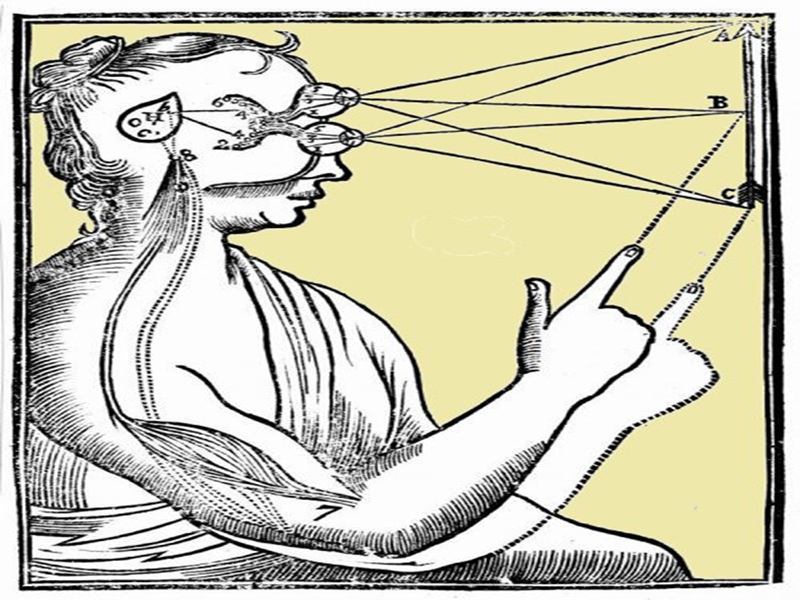
When you guide the eyes by tracing the movement of your thumb, you are actively retraining coordination. Moving the thumb slowly from side to side develops horizontal tracking and smooth pursuit, which are essential for reading and scanning without strain. Vertical movements balance this by engaging a different set of muscular pathways that are often underused. Circular tracing, done both clockwise and counterclockwise, integrates the full range of motion, preventing stiffness and fragmentation in how the eyes move. Bringing the thumb slowly toward the nose and then extending it outward again trains convergence and divergence, directly working the ciliary system that governs focus. This is one of the most important elements for long-term eye health, because it restores the ability to shift comfortably between near and far distances—something that deteriorates under constant screen exposure.
What’s happening here is subtle but significant: you are increasing circulation to the ocular muscles, improving neuromuscular coordination, and restoring elasticity in the focusing mechanism. Over time, this can reduce strain, improve endurance, and make vision feel clearer—not necessarily by changing the structure of the eye in a dramatic way, but by making the system function more efficiently. This aligns with modern findings that practices like trāṭaka improve visual comfort and reduce fatigue, even if they don’t radically alter refractive errors (which in some cases they do, too!).
Once the eyes have been prepared through movement, the role of classical trāṭaka—now including candle gazing—comes into its proper place. The candle flame provides a stable, high-contrast point that naturally draws the gaze into stillness. Here, the training shifts from movement to stability. The eyes are allowed to settle on the flame, blinking reduced but never forced. This phase strengthens the ability to maintain a single point of focus without micro-adjustments, which in turn reduces cognitive agitation. It is less about “holding” the gaze and more about letting the system quiet down into it, refining not only the eyes, but the psychophysical system overall.
The internal phase that follows, where the afterimage is observed with the eyes closed, continues this stabilization at a neurological level. The visual system is now operating without external input, and the mind learns to hold an image without chasing or distorting it. This is where the classical descriptions of trāṭaka begin to bridge into the psycho-spiritual domain. The same mechanism that steadies the eyes begins to steady perception itself.
But for eye health, this must be balanced. After sustained focus, the system needs release. This is where horizon or sky gazing becomes indispensable. When you look into the distance without fixing on a specific point, the focusing mechanism relaxes almost completely. The ciliary muscles release, the visual field widens, and the nervous system shifts toward a parasympathetic state. This is not just relaxation—it’s recovery. It counteracts the contraction created by both screen use and focused gazing practices. In many ways, this is the missing piece in how trāṭaka is commonly taught today. Without it, you risk reinforcing the very tension you are trying to undo.
When all three elements are combined—movement, stillness, and expansion—you get a complete and sustainable system. The thumb-guided exercises build strength and flexibility. The candle gazing builds precision and stability. The horizon gazing restores openness and ease. Together, they create a rhythm that the visual system actually thrives on: contraction, control, and release.
Over weeks, sometimes months, (honestly, sometimes even years) of practice, the changes are gradual but noticeable. The eyes feel less tight, less fatigued, and more responsive. Shifting focus between distances becomes smoother. The urge to squint or rub the eyes decreases. Vision can improve noticeably. There is also a quieter, less scattered quality to perception itself, which reflects the deeper intention of trāṭaka as described in the classical texts. The outer work—moving the eyes, fixing the gaze, relaxing into space—begins to influence the inner field of attention in a way that is direct and experiential.
This is where the physical and the psycho-spiritual meet without contradiction. You are not forcing insight or chasing altered states. You are simply restoring function of the eyes, of attention, and of the link between them. The traditional language speaks of purification and subtle vision; the modern language speaks of neuromuscular coordination and attentional control. In practice, they are describing the same arc from different angles.
Brief Training Protocol
Physical Phase (3–5 min)
- Thumb tracking: side-to-side, up/down
- Circular tracing (clockwise + counterclockwise)
- Thumb in–out (toward nose and away for focus training)
- Palming (30–60 sec)
Focus Phase
- Candle gazing (1–5 min, steady, relaxed, minimal blinking)
- Eyes closed: observe afterimage
Release Phase
- Horizon / sky gazing (2–5 min, soft unfocused vision)
Cycles & Frequency
- 1–3 rounds (15 min max total per round) 5 days/week
- Enjoy frequent ‘light days’ with distance gazing only
Train the eyes through movement,
refine them through stillness,
restore them through distance.
Contact me directly for personalized guidance.

…is a natural mystic, Śaiva-Śākta Tantrika and Jñāna Yogī. David holds degrees in Eastern Philosophy and Semiotics, lives in Japan with his family, and works as an author and teacher of the wisdom traditions, devoting his time to developing science-based tools and programs that help people reach the fullest potential of the human condition. This site is the legacy of the Himalayan Ashram—Uma Maheshwara Yoga & Ayurveda (UmaMaYA).
Would you like to share this article?

Discover more from REAL YOGA
Subscribe to get the latest posts sent to your email.